Panoramic X-rays make dollar$ and ¢ents
Panoramic X-rays not only provide tangible clinical advantages for your patients, but ethically/Deontology also pay for themselves quickly through cost-savings and a new revenue stream.
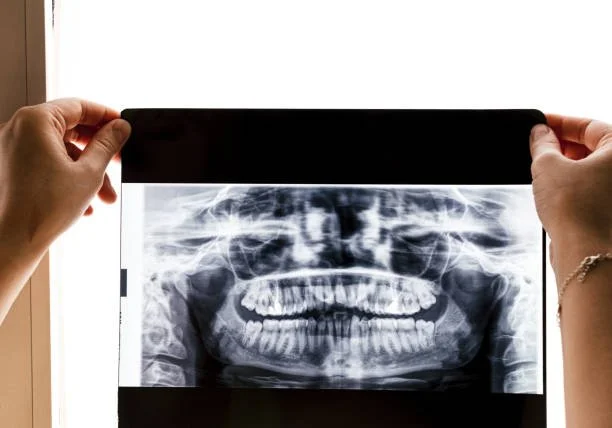
x ray of a full set of teeth
Panoramic radiography has proven to be a tremendous diagnostic tool, so it is surprising to find that some practices, based on clinical benefits alone, still do not have a panoramic X-ray machine. Panoramic radiography offers a multitude of clinical- and patient-care benefits that make it by far one of the most valued tools in diagnostics and treatment-planning available to the dentist. Volumes of papers, case studies, and reports highlight the clinically significant — and sometimes life-saving findings — attributable to the use of panoramic radiography. The clinical and treatment benefits for your patients should be the primary reasons for considering a panoramic system, and these alone make it a worthwhile investment.
However, another element of the equation is the financial benefits offered by panoramic X-ray systems. Manufacturers talk about the different ways that panoramic machines can pay for themselves. Many dentists claim their machines pay for themselves within six months.
So what is the real cost of a panoramic X-ray machine? This article will explore the idea that a panoramic radiography system — in addition to providing tangible clinical advantages for your patients — also can pay for itself fairly quickly through time and material savings and direct revenue generation. All of this depends, of course, on the size and volume of the practice and the degree to which the office integrates panoramic radiography into its diagnostic procedures.
Our research did not find any one source that addressed all of the economic issues. What follows is a fairly comprehensive description of the financial aspects of panoramic ownership, culled from several manufacturers, distributors, and dental office sources. A simplified worksheet is available with this article on Dental Economics' Web site
(www.dentaleconomics.com) to make it easy for you to do the economic analysis and payback review that you should before purchasing or renting any piece of major capital equipment. Not all of the points on the review will apply to every dental practice, and some may overlap or only partially apply to your practice. Be realistic about your own circumstances and plug in figures that are reasonable for your own dental business.
1 The true cost of the equipment — You must calculate the true, net after-tax cost of the equipment before doing your evaluation. This calculation should factor in any tax benefits available to you and your practice. According Various Taxes governments you may deduct all or part of the cost of the equipment in the year the equipment is placed into service, instead of using the standard depreciation method. Talk to your accountant or tax expert about the best method to use for your individual practice. For example, if you paid $9,500 for a panoramic X ray machine, you might be able to take a $9,500 income tax deduction in the year of purchase, which, assuming a 35 percent tax bracket, lowers your after-tax cost to $6,175.
2 Periodic Screening of asymptomatic patients — Many dental schools and dental-radiology experts recommend the use of a panoramic radiograph in conjunction with bitewings as a replacement for the full-mouth series (FMX)* of X-rays. This follows the guidelines for periodic screening recommended by the ADA. In fact, the ADA recently asked the FDA to update its guidelines on dental X-rays to further address the issue of radiographic-selection criteria for the asymptomatic dental patient. ( FMX* Full Mouth Service of X Rays )
Some dentists conduct this screening on all patients every year, but this may not be necessary. Always keep in mind that the use of X-rays should be based primarily on your professional evaluation of the clinical needs of each patient. If the suggested full screening with panoramic radiographs is conducted every three years for all dentulous patients — replacing the full mouth series — the revenue generation would look like this:
Over three years, 2,100 panoramic films at $62 + 2,100 sets of four bitewings at approximately $38 = $210,000 in revenue. Subtract the current revenue of 2,100 FMX at approximately $54 per series ($113,400), and you will see a gain in revenue of $96,600 over three years.
These calculations were based on a practice with 2,100 active patients, because that is close to the average number of patients per practice. But, keep in mind that these are examples and averages. Every patient is different and must be handled individually, based on your evaluation of his or her specific clinical needs.
3 New patients — As new patients enter the practice, it certainly is worthwhile to take a panoramic image and bitewings as a baseline to develop an overall treatment plan and to determine the overall oral health of the patient. This is diagnostically correct and justifiable to reimbursement agencies. If you add a panoramic plus bitewing screening for 150 new patients during the year, you could conservatively generate $6,900 in new revenue:
| Practice Revenue | |
| 150 × $62 (Pan Average) | $9,200 |
| 150 × $38 (Bitewings) | $5,700 |
| Total Pan & BW | $15,000 |
| Subtract FMX Fee | -$8,100 |
| Net Practice Revenue Gain | $6,900 |
4 Possible productivity gains — When a panoramic radiograph and bitewings are used to replace the full-mouth intraoral series (FMX), there also are gains in time and productivity. An FMX procedure requires about 20 to 25 minutes for a quick auxiliary, an additional 10 minutes to unpack and process the film, and another two to three minutes to mount and label it. The entire process can average between 32 to 37 minutes. A panoramic with bitewings should take two minutes for the pan, three minutes for the BW, and seven minutes for processing and mounting — for a total of 12 minutes. This savings of 20 minutes per patient is valuable
auxiliary time that can be redirected to actual patient care, patient call-backs, or other productive efforts on the part of the staff. The following outlines the time and dollars involved:
Estimated Gain on Time saving. $ 1 700 ( ask for the detail of the study )
5 Material savings — In addition to potential productivity savings, there is an actual cost reduction in the amount of film and film mounts used.
Estimated Gain on Material Savings. $ 4 500 ( ask for the detail of the study ) *There also may be a savings in film mounts depending on the type and brand used.
7 Additional new procedures — In many cases, the use of a panoramic radiograph will help to identify additional needed dental procedures that would not have shown up on a normal FMX or other cursory screening. Many endodontic, operative, and oral-surgery procedures have been identified first on a panoramic radiograph. Although it is very difficult to assign a number to this, let's just estimate that 5 percent of all panoramic radiographs you make will result in identifying otherwise undetected, but necessary, procedures. If your practice has 2,100 patients and you produce a panoramic radiograph on one-third of your patients each year, that equals 700 panoramic films per year, plus 150 new patients annually — for a total of 850 panoramic images. If 5 percent need additional operative, restorative, or surgical work, that adds up to 43 new procedures per year. It could be a crown, a bridge, a periodontal procedure, or an endodontic procedure requiring surgical intervention ... or many other possibilities. Lets say it averages out to $350 per new procedure.
850 pans per 5% = 43 new procedures charge of $350 = $ 15 000 in new revenues
8 Orthodontics — Many general practitioners have become more involved in orthodontic procedures recently. This trend will most likely continue as new products are introduced that make it easier for the general dentist to get involved in selected orthodontic procedures.
With orthodontics, you need a cephalometric attachment for the basic panoramic unit. This does add some cost to the system; however, the "ceph" attachment can add substantially to the revenues generated. A cephalometric-image charge can be $80, versus an average of $62 for a panoramic image. If you did 100 cephalograms per year for orthodontic cases, that would amount to $8,000 in additional revenues, more than enough to pay for the added cephalometric attachment in a relatively short time.
9 Increased rate of treatment acceptance — Patients have a much easier time understanding treatment options and recommendations when a panoramic radiograph is used during the case presentation. New users often find that their patients really like the panoramic radiograph, because they easily can visualize the dental problem and recommended solution. This typically
results in increased case-acceptance rates and, as a result, better treatment outcomes for the patient. Five to 10 percent increases in patient acceptance are not uncommon when panoramic radiographs are used during the presentation. Remember the old adage, "Seeing is believing." The use of panoramic radiographs can have a significant financial impact on a dental practice and result in better clinical treatment and more satisfied patients.
What is the result if you increase patient acceptance by 5 or 10 percent?
| Increase | Acceptance Rate | Gross Y Revenue | Increase Y Revenue | Increase M Revenue |
|---|---|---|---|---|
| 0% | 68% | $413,000 | $0 | $0 |
| 5% | 73% | $433,000 | $20,000 | $1,666 |
| 10% | 78% | $454,000 | $41,000 | $3,416 |
| *68% is the average acceptance rate | ||||
Whenever clinically justified, panoramic radiographs should be taken as part of your overall evaluation and diagnosis. When they are, it makes great sense to incorporate them into your treatment-plan presentations. You will find that patients will better understand what is needed and will be more willing to accept the proposed treatment.
Calculation guide
You will find a calculation guide on the Dental Economics Web site (www.dentaleconomics.com).
Print it out and use it as a tool to help you analyze the financial impact of panoramic radiography on your practice. The dollar figures in the guide correlate to the points in this article and are presented as examples. The blank column is for your actual practice numbers. Obviously, no single practice will exactly emulate these examples, but they should make it easier for you to calculate the financial impact of a panoramic system on your practice. You may be pleasantly surprised by the results.
Reap the rewards
Panoramic radiography offers tremendous clinical, diagnostic, and patient benefits. These alone are enough to justify the purchase or rental of a panoramic machine. In addition, the economic benefits make you wonder why every practice does not have a panoramic machine. Panoramic radiography is one of the truly unique products in dentistry. It offers greatly enhanced clinical and diagnostic benefits, while generating a substantial growth in revenue and net income that will continue for years to come. What a great combination!